
Custom 925 Sterling Silver Jewelry: MOQ, Plating and Hallmarks
Minimums run 100 units in artisan brass, 50 pcs in 925 silver and 100 plus in stainless, design by design quoted per design. It still carries the same sampling window of 25–30 days, the same eight factory steps and the same plating choices — 14K, 18K and 24K gold or rhodium, with an anti-tarnish e-coating. Here is how the numbers fit together.

Key takeaways
- MOQ for 925 sterling silver is 50 pieces per design, the lowest of the three published material floors.
- 3D Under 48 hours for the CAD, 25–30 days of sampling, 3–4 weeks of production — that is the full published run.
- Silver takes multi-layer gold or rhodium plating plus a protective anti-tarnish e-coating.
- On the compliance side: An audited BSCI social-compliance programme, REACH limits on lead, cadmium and nickel and ISO 9001:2015, cadmium and nickel.
Why the silver minimum is the lowest of the three
Minimums follow tooling, and silver is the easiest of the three materials to tool and finish. It casts cleanly, polishes to a high gloss without the prep brass needs, and can be plated or left bare. That combination is why the floor sits at 50 pieces per design rather than 100, and why a first collection with several designs is usually cheaper to start in silver than in a plated base metal.
The trade is material cost. A silver design carries metal value that brass does not, so a 50-piece run in 925 sterling silver and a 100-piece run in eco-brass commit differently. For a brand testing four designs, silver gives 4 × 50 = 200 pieces as the tooling commitment, while the same four designs in brass is 400 pieces — twice the volume, at a lower material cost per piece.
What the published process does with a silver design
The sequence is the eight-step one: concept design in hand and CAD, prototyping by mould or 3D printing, sprue cutting, high-gloss polishing, brushed or textured surface art, electroplating, final inspection at 100% and delivery. Silver goes through the wet route with brass, so it shares the plating tank and the anti-tarnish e-coating line.
The two windows that matter are the same for every metal. 3D CAD is under 48 hours and produces drawings and renderings for dimensional sign-off. Master sampling is 25–30 days and covers 3D wax printing and casting in a precision mould, before stone-setting, polishing and custom plating. Mass production after approval is 3–4 weeks.
Plating and the anti-tarnish question on silver
Silver takes multi-layer electroplating in 14K, 18K or 24K gold, or rhodium for a white finish. Rhodium over silver is the least visually disruptive combination available, because the base metal is already white, and it is the usual way a brand adds a brighter, harder-looking finish to a silver range without changing its colour story.
Where a piece is left bare or plated, the anti-tarnish e-coating is the layer that decides how long it reads as new. The published hallmark for the silver route is S925, cut with laser engraving alongside any custom logo. Ask for the coating sequence in writing, because a hallmark cut after the coating reopens the surface it just sealed.
| Item | Published figure | What it decides |
|---|---|---|
| Silver MOQ | 50 pcs per design | How many designs a first order can carry |
| 3D CAD | Under 48 hours | How late a shape can still change |
| Master sampling | 25–30 days | The date the sample is approved |
| Mass production | 3–4 weeks | The delivery date on a first order |
| Hallmark | S925 | What the finished piece declares |
Compliance: what each statement does and does not cover
Three compliance positions are published. ISO 9001:2015 is a quality management system, and the factory describes it as a rigorous quality control system across all production stages — it is a claim about documented repetition, not a claim that every piece is perfect. A BSCI audit covers social compliance: safe conditions on the floor, ethical labour standards and ethical sourcing across the supply chain. REACH compliance is a materials statement, and it names lead, cadmium and nickel specifically.
None of the three is a substitute for a sample. What they do is tell you which documents to ask for when a retail partner raises a question, and which of them is relevant: labour questions go to the audit, restricted substances to the materials statement, and process consistency to the management system.
Choosing a manufacturer for a silver range
Ask for the four numbers that decide everything: the per-design minimum, the sampling window, the production window and the hallmark. A sterling silver jewelry manufacturer that publishes all four can be compared with another on the same page, which is rarely true of a supplier quoting a single price and a promise.
Then ask the finishing question: whether the anti-tarnish e-coating goes on after setting and engraving. On a silver piece with a stone and an S925 mark, that answer determines whether the joins stay sealed or whether tarnish starts at the two places the piece was cut last.
Nickel-free silver, the S925 stamp and sample testing
The sterling line states that the silver is nickel-free and allergy-free, and that every piece is stamped "S925" to identify it as genuine 925 silver. Plating on those pieces uses eco-friendly electroplating, so a plated silver design is not a contradiction: the base-metal statement and the finish are both published, and a buyer can quote either one with confidence.
The process point that matters most to a first-time buyer is sample testing — a physical sample approved before production starts — alongside accurate 3D design, quality plating, strict QA and fast delivery. Read in order, those five service points are a short audit trail, and the compliance block sits behind them: ISO 9001:2015, a BSCI audit and REACH under EU safety standards.
Worked example: five compliance checks behind one compliant order
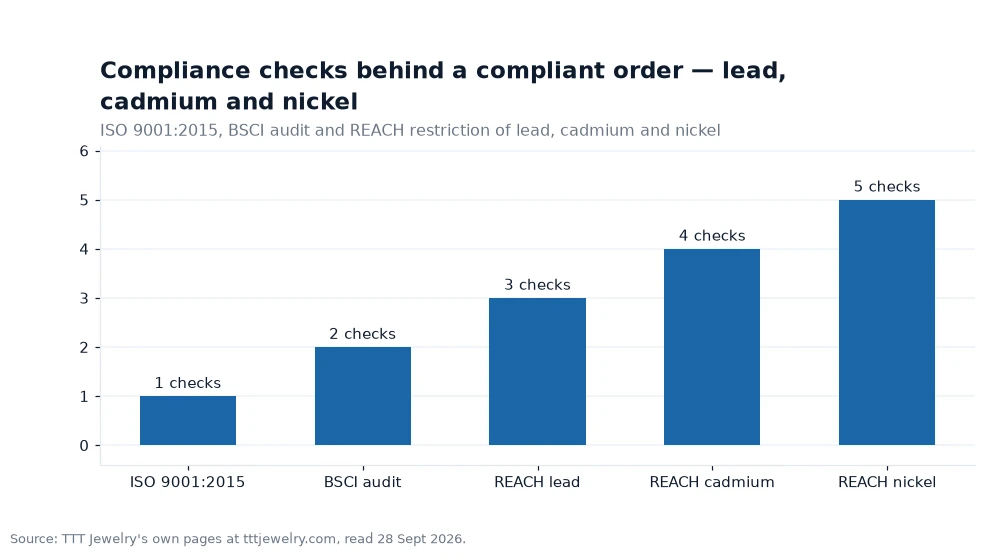
Count the compliance items behind a silver order: An audited BSCI social-compliance programme, ISO 9001:2015 and REACH restrictions on lead, cadmium and nickel. That is 5 separately verifiable items, and each is a document with a date attached rather than a claim on a web page.
Now relate them to the batch. A 50-piece silver run is 50 pieces, 100% of which are inspected before packing, so the compliance chain covers 50 ÷ 50 = 100% of the order rather than a sample of it. My arithmetic; the five items and the 100% inspection point are the published ones. Ask for document dates at the same time as the sample, and the two arrive together.
Frequently asked questions
What is the minimum order for a silver design?
The floors are 100+ pcs in the stainless line, 50 units in 925 silver and 100 units in eco-brass, design by design, which doubles again for a two-design range.
Can silver be plated, or is it sold bare?
Both. Silver takes multi-layer gold plating in 14K, 18K or 24K, or rhodium for a white finish, and either way it can carry an anti-tarnish e-coating.
Which compliance documents should be requested?
ISO 9001:2015 for quality management, the BSCI audit for labour conditions and the REACH materials statement covering lead, cadmium and nickel.
Starting a silver range with the numbers in hand
Fix the design count first, because 50 pieces per design is what makes a multi-design collection affordable: four designs is 200 pieces of tooling rather than 400. Then decide the finish before the CAD file is approved, since plating and the anti-tarnish coating are settled at the drawing stage rather than at the tank. Finally, ask for the compliance documents and the sample in the same message, so the piece and the paperwork that describes it arrive together. Brands comparing metals usually run the same design in silver and brass to see how the price and finish differ — the brass route is set out on the brass manufacturing pages, and the full service list sits on the factory overview.
Where the numbers come from — the S925 hallmark on every piece plus the full-inspection rule and the ISO 9001:2015, BSCI and REACH statements — is the factory's own site via tttjewelry.com, checked 28 Sept 2026. The relative figures in the chart belong to me rather than the client, not the site's[1].